The context
Azure Container Apps is a serverless container platform that lets developers run modern applications without managing the orchestration underneath. After launch it was acquiring developers steadily — but growth was decelerating, and a large share of new users weren't sticking past their first weeks.
As the embedded UX Researcher for the Developer Compute organization, I owned the growth, retention, and churn research program — a connected series of studies structured around the full customer lifecycle, from acquisition to churn.
The business problem
Leadership could see the numbers softening but had no customer-grounded explanation of why developers activated, stalled, or left. Two things stood out:
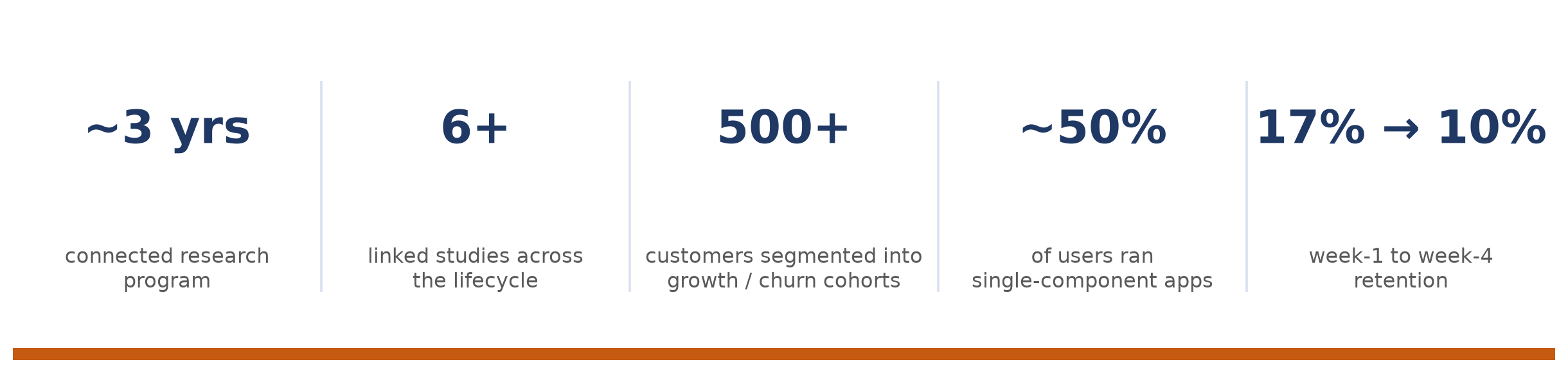
The activation cliff. Early retention was weak — week-1 retention sat in the high-teens percent and fell to roughly one-in-ten by week 4. The drop-off was concentrated at activation, not acquisition.
A design–usage mismatch. The platform was built for microservices, yet about half of its users ran single-component apps. Most people weren't showing up for the marquee value proposition.
The activation cliff
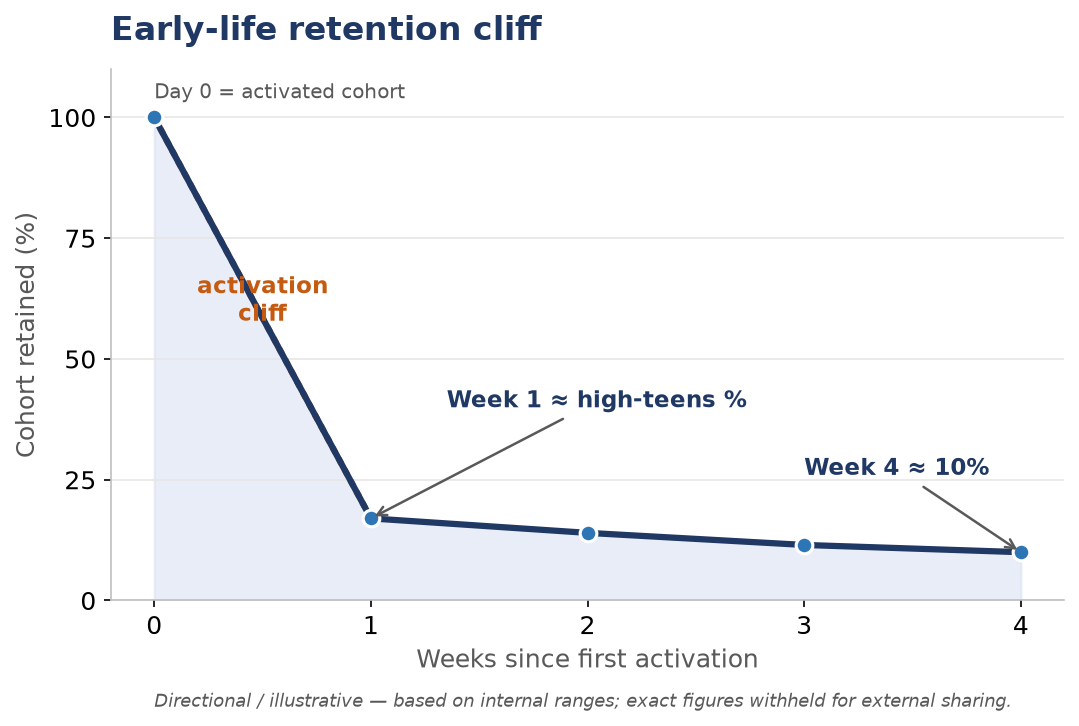
Activation — not acquisition — was the bottleneck
- Week-1 retention held in the high-teens %; by week 4 it was near 10%.
- Day-0 cohorts churned fastest — right after the first successful (or failed) run.
- Acquisition wasn't the leak. The first-run experience was.
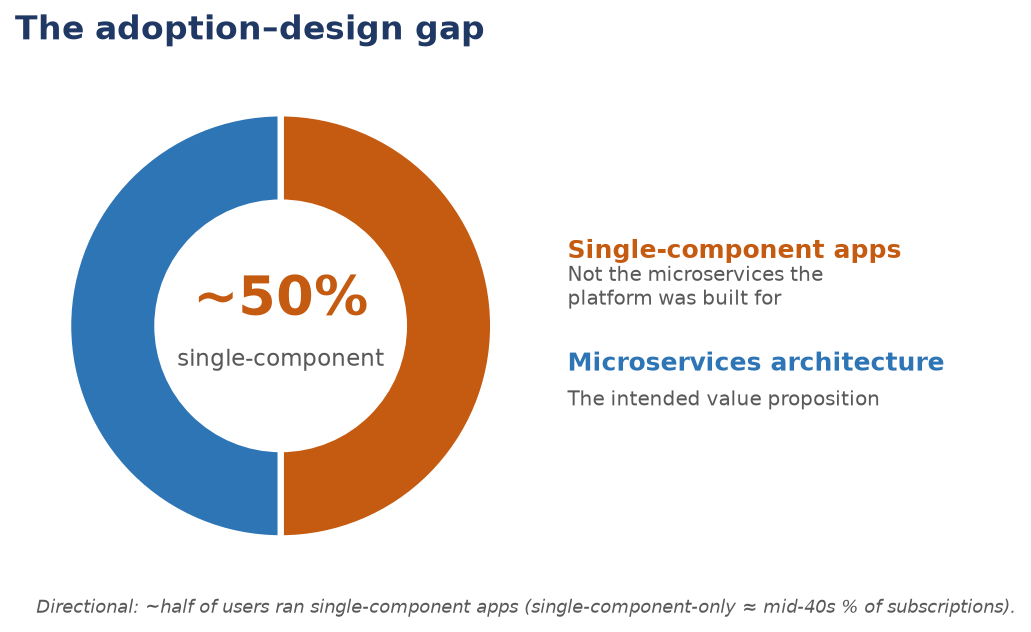
Built for microservices — used for something simpler
~Half of users ran single-component apps, not the microservices the platform was designed for.
Containers were a means to an end — developers came for developer experience, scale, and cost.
The implication: serve the first-app scenario, not only advanced users.
A diverse research toolkit
I ran a longitudinal, mixed-methods program that moved deliberately from generative to quantitative — triangulating what developers said with what they actually did, and synthesizing it into strategy for leadership.
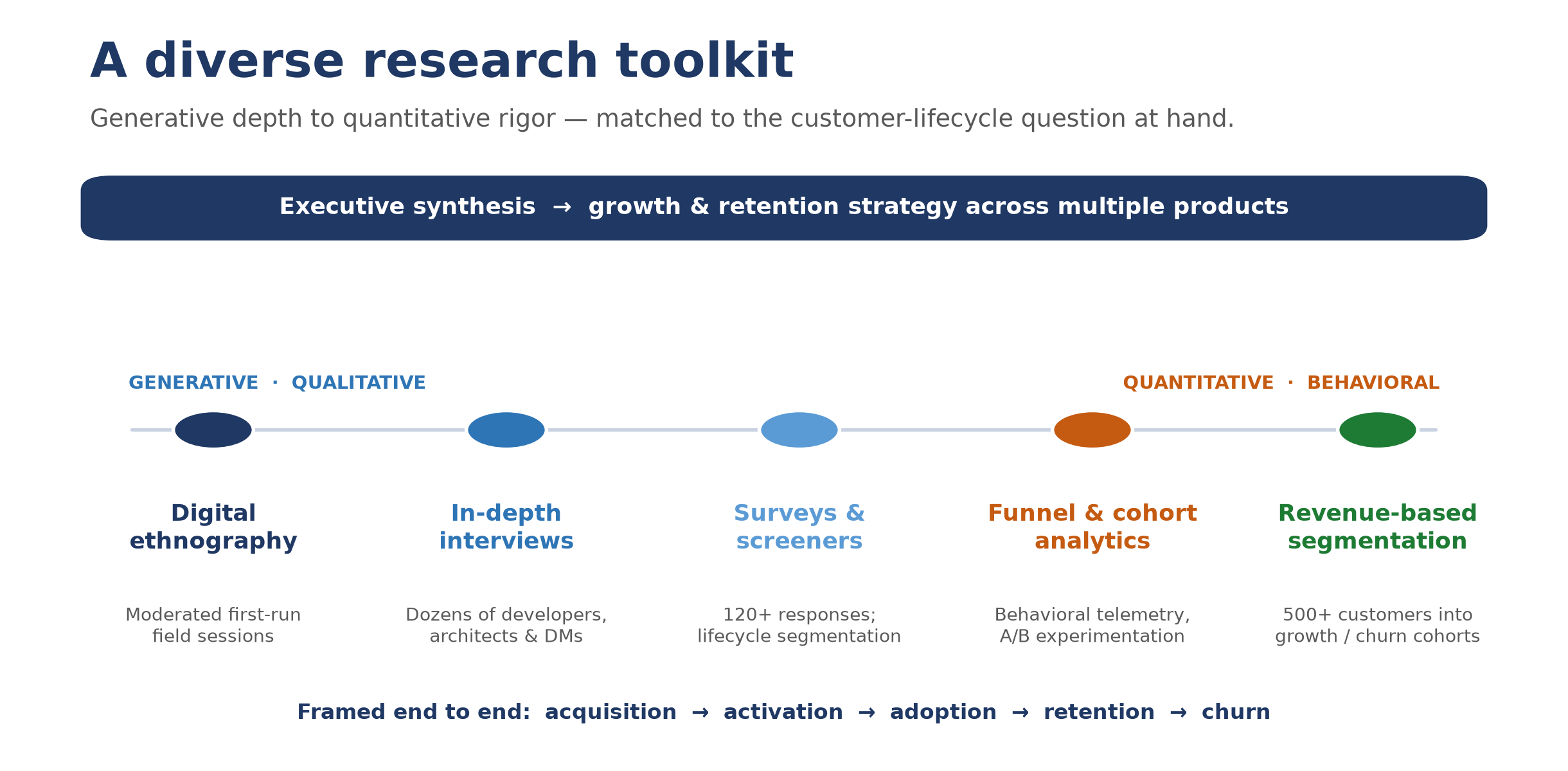
Digital ethnography — moderated first-run field sessions
In-depth interviews — developers, architects, and decision-makers across enterprise, ISV, consulting, and startup segments
Surveys & screeners — lifecycle-stage segmentation and ranked churn drivers
Funnel & cohort analytics — behavioral telemetry and A/B experimentation
Revenue-based segmentation — recruiting growth vs. churn customers precisely
Executive synthesis — turning cross-study insight into growth strategy
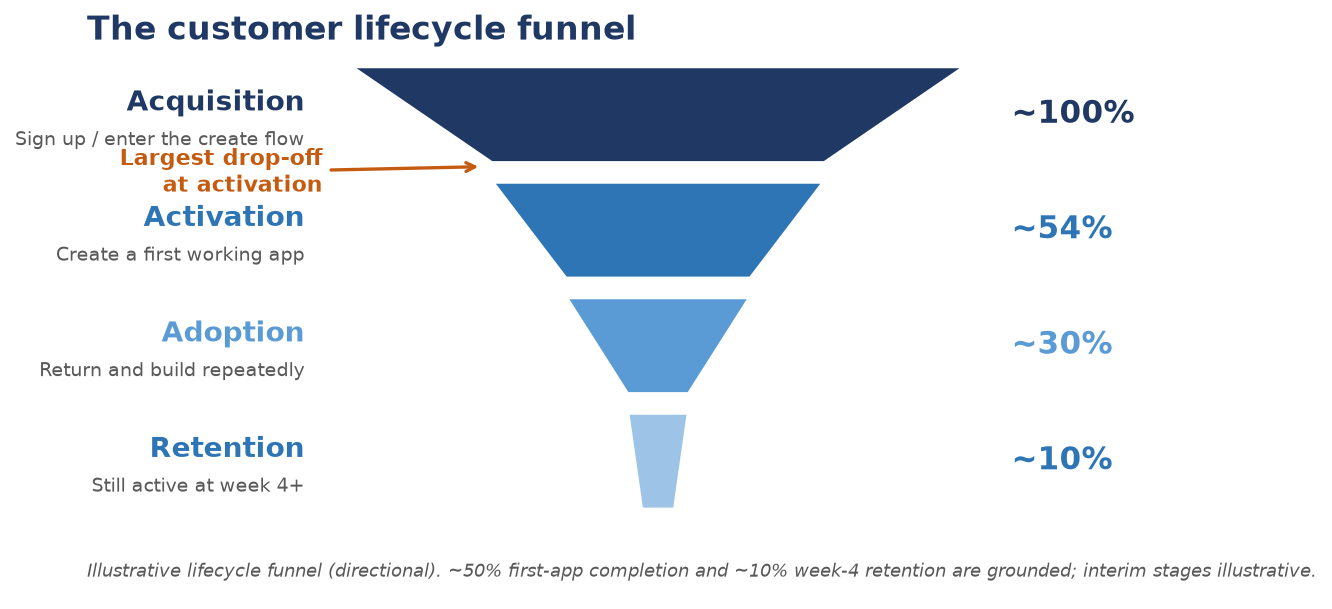
The reframe: win the first run
The research shifted the growth thesis from "sell microservices" to "win the first run." The biggest lever wasn't acquisition or advanced features — it was getting a developer to a first working app, then through the early weeks. That single reframe reorganized how the team prioritized growth.
Impact on product direction
The roadmap refocused on the activation moments the research showed were decisive:
Onboarding simplification — cut container/Docker friction; streamline the path to a first working app.
Safer defaults — so a first-run mistake can't silently cost money or stability.
Guidance & templates — opinionated, scenario-based starting points for security, scale, and cost.
Cost transparency — surface cost early to prevent the "surprise bill" abandonment pattern.
First-app scenarios — explicitly serve single-component and first-app users, not only advanced microservices.
Outcomes & influence
Set the lifecycle research agenda — the acquisition → activation → retention → churn spine used to organize growth planning.
Built a repeatable segmentation method — revenue-based cohorting to recruit growth vs. churn customers precisely, durable beyond any single study.
Gave PMs a decision-ready backlog — an evidence-ranked (validated / invalidated / inconclusive) hypothesis matrix.
Informed measurable funnel wins & executive strategy — findings fed a funnel-experimentation program (create-flow lift, faster time-to-value) and shaped growth strategy across multiple products.
What I'd take forward
Instrument the lifecycle, not the feature — the unlock was reframing around activation and early retention.
Triangulate to build trust — pairing qualitative "why" with behavioral "what" moved leaders who discount qual alone.
Recruit with data — revenue-based segmentation put the right customers in the room.
Meet developers where the value is — they adopt for outcomes: developer experience, scale, and cost.
This case study has been anonymized for public sharing. Customer names, revenue, internal project names, unreleased features, and exact internal metrics have been removed or expressed as directional ranges.